Posts

Eve Ensler's SUDDENLY, MY BODY: watch it, then write what matters

Image
I just watched Eve Ensler's powerful new 12-minute video on  TED . I immediately wanted to reach out to all the women in my life. And to all the men who love but are confused by the women in their lives.  Please don’t miss  Suddenly, my body .  Watch it with a friend. Watch it right now. Watch it tonight with a glass of wine or in the morning with a cup of tea. Watch it with your mother, or your daughter, or your husband, or your son. Watch it with your journal in one hand and a fistful of earth in the other.  Eve's story reminds us of our deep kinship with nature, of the emotional link between the bodies of women and the body we call Earth.  If her story reminds you of your story, seek out a healing moment in a place of intrinsic beauty--a moment as perfect as a flitting butterfly poised on a wild flower.  Let nature pollinate you.  Let it feed your art.  If you must choose between reading the rest o...

What do Butler's A Small Hotel, Louv's The Nature Principle, and Abram's Becoming Animal have in common?

Image
Well, for one thing, the first two book titles made the list of Oprah's top 27 summer reads .  The third, Becoming Animal, should have, but didn't.  A Small Hotel, Robert Olen Butler's latest work of fiction, is an unapologetic romantic story of a couple in love for nearly 25 years but now in the throes of separation and divorce.  (I first met Butler about six years ago at a Narrative Magazine fundraising dinner in Santa Fe, New Mexico.)  Butler read from   Intercourse , his 2008 collection of irreverant short stories that, through humerous paired dialogues, allow the reader to romp through imagined sexual moments of some very famous characters. It's a very "fleshy" book, but more about "connections" than separations, which is the theme of A Small Hotel. Richard Louv's latest book, The Nature Principle: Human Restoration and the End of Nature Deficit Disorder is also about separation (you'll have to look a little harder f...

Fierce and Hopeful Attachments

Image
I have a file box on my desk next to my Storyteller Doll with clippings torn from magazines and newspapers -- uplifting stories of people reconnecting to the land.  These stories appear in diverse publications, like Native Peoples Magazine and High Country News , or The Quivira Coalition Journal and the Nature Conservancy , even the World Ark and The Denver Post . The Omeg family in Oregon has planted blanket flowers and catmint around the perimeter of their cherry orchard so that threatened bumblebees, mason bees, and even sweat bees will have blossoms to sustain them. In the heart of Navajo country, Tammy Herrera is reconnecting people to the land and helping teach horsemanship to youth through a feral horse 4-H program  (see pg.22 of pdf). In a small Amazon village in the Oiapoque region of northern Brazil, children are helping to restore native populations of tracaja, the green and yellow river turtles. In Colorado, prison inmates are training mustangs that are l...

Inside the DAM: Roxanne Swentzell, Mud Woman, and The Whisper of the Land

Image
Sometimes, the most memorable moments for an artist or writer are hidden. Sometimes our work itself is hidden. Several weeks ago Roxanne Swentzell told me over dinner and a glass of Blue Moon that she had inserted a PVC pipe into Mud Woman’s center to stabilize the 10-foot-tall sculpture. “But now I have this space that runs from her head to her heart,” she said. “I need to put something special in it. Maybe you have a poem about Denver?” Mud Woman is monumental—certainly not hidden.   The Denver Art Museum commissioned Roxanne to create the piece for their new Native American exhibit and, after months of planning, Mud Woman is coming to life.   The sculpture, officially named Mud Woman Rolls On , is the first thing that greets visitors when they step off the 3 rd floor elevator of the DAM, Denver ’s world class art museum.   Roxanne, a world class sculptor, will be working on the piece all spring and summer .  Rox  is from the Santa Clara Pueblo in N...

Celtic Blood, Cherokee Blood, and Nature's Earthly Spirits

Image
Helen Terry Dunton c. 1912 When I asked my redheaded Great Aunt Violet, who died many years ago but in whose western saddle I still ride, to tell me what she remembered about my paternal grandmother, she said, "Well, besides being a crack shot with a rifle, Helen was part Irish, and part Cherokee , and that wasn't a very good thing to be back then."   Auntie Vi was from the Dunton clan, my father's clan. "We have Scots blood," was the pronouncement, and I took it to mean that Scots blood was somehow superior to the Irish blood my grandfather had married into.  The Cherokee blood was rarely mentioned, and never with "princess" lineage claims. I continue to research this claim but have found no direct lineage tying me to enrolled ancestors, only the names of distant cousins and ties to Cherokee communities in Oklahoma such as Wauhillau and Stilwell. Beyond the American Pale In David M. Emmons book, Beyond the American Pale: The Irish in th...

Research is not a dirty word. Or: A story about an elk, an eagle, and two-hearted women

Image
Bull elk on Lookout Mountain  in snowstorm Writing is not just about what we already know.   It's also about what we wish we knew.  At this juncture, where facts and experience meet curiosity, inspiration takes root.  Passion and our emotional connection to a story may form the heart, but research gives a story legs; it keeps the story moving forward and keeps writer and reader engaged.  Research is exploration.   It is venturing into unknown territory, and the tension created between knowing, and not knowing, like a taut rubber band, can catapult us into someplace new. Take this elk, for instance.   Large antlers serve bull elk  well during the rut, when they're sparring to test strength and endurance and hopefully gather up a harem of cows. But twice this winter, my neighbors and I have seen big bulls tangle with the orange plastic mesh fencing used on construction sites. This particular  bull is...

Behind the Chutes: Filmmaker Ann Lukacs On the Art of Storytelling

Image
Ann Lukacs shooting from helicopter I first met award-winning filmmaker Ann Lukacs in Gunnison, Colorado back in 2004 when I was speaking at a Writing the Rockies conference.  My topic, "Embracing Passion: In Our Stories and In Our Lives," seems to be a guiding motto for Ann, too. Last Tuesday, she was the keynote speaker at Dr. Ellie Greenberg's Feminist luncheon in Denver (Greenberg is the co-author of In Our Fifties: Men and Women Reinventing Their Lives and of A Time of Our Own: In Celebration of Women Over Sixty ), where she shared with us her journey as a filmmaker, and her devotion to the story beneath the photos. A Time Of Our Own A few of Ann's professional credits as a cinematographer include Pirates of the Caribbean, The Bucket List, Honeysuckle Rose, Blues Brothers, and Coal Minor's Daughter.  Check out the New York Times for a list of movies featuring more of Ann's work behind the camera. photo by Ann Lukacs  But the movie that se...

The Moral Dilemma of My Mother's Mink: Earning Our Place in the World

Image
My mother’s mink stole and two fur collars, one sable, one white, have been hanging in the back of my closet since she died five years ago.  I remember how beautiful she looked to me as a child when she wore her mink—how the soft fur graced her bare sloping shoulders and showed off her own mother’s strand of pearls—how proud my father looked as he offered my mother his arm. The mink stole symbolized to my father his ability and desire to provide for my mother (not unlike what his grandfather must have felt when he dragged a deer back to his waiting wife). Old Fugate Sawmill, Stringtown, OK read essay My grandmother never wore a mink stole, though.  She had been born in Indian Territory—the child of a laboring, mixed-blood family that logged for the railroad companies as they laid track from Arkansas and Kentucky and Oklahoma west to Washington.  Judging from old family photos, they ate a lot of deer meat—and rabbit.  Members of the weasel family, no doubt, provi...

Can you trace the heart of your story? Great racehorses like Secretariat can.

Image
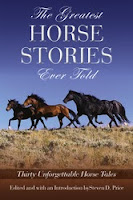
Several years ago , I read the essay "Mt. T's Heart," by novelist Jane Smiley , the first essay in the collection The Greatest Horse Stories Ever Told . I've been fascinated by the idea of "great hearts" ever since--both the hearts of horses, and the hearts of stories.  If the stories we love to read over and over again endure because of this hard-to-measure quality, how can we ensure that the heart of the story we're writing now will tick on and on?   If you could weigh the heart of your story—feel its pulse in the palm of your hand—could you trace its genetic greatness back to the works of the authors whom you most admire?  Would there be a “felt” line of descent between your story and the first story you ever read as a child that made your heart race, perhaps Mary O’Hara’s My Friend Flicka or John Steinbeck’s The Red Pony?  What do I mean by “felt line of descent?” Let’s use a metaphor and explore the literal and figurative “heart” of the race hors...