Posts

Why Vultures Lie in Wait, and Deepak Chopra’s Law of Least Effort

Image
I grew up believing that STRIVING towards goals and feeling DRIVEN in one’s passions were necessary components of success. They can also be exhausting components of success.  Deepak Chopra, in his book The Seven Spiritual Laws of Success , talks about the Law of Least Effort. “Nature’s intelligence functions with effortless ease…this is the principle of least action, of no resistance.” But what of all those long tedious hours of writing and rewriting? What of all the hours spent networking, following up leads, peaking under every stone for missed opportunities? The carrion-eating vultures I encounter on early-morning hikes got me to thinking that maybe Deepak Chopra is right. “Grass doesn’t try to grow, it just grows,” he tells us. “Birds don’t try to fly, they fly.”  Vultures are “least effort” opportunists, willing to watch and wait, poking their bald red heads into putrefying places and coming up with enough to feed themselves and their not-too-picky young. Pa...

The Wind in the Willows & Love of Place

Image
Kathleen Cain begins her review of Standing in the Light by Sharman Apt Russell (Bloomsbury Review, May/June/July 2009; http://www.bloomsburyreview.com/ ) this way: “I’ve been waiting for this book all my life…I am urged to awe that equals spiritual fervor in the presence of Nature.” What is it about Nature—Nature with a capitol N as depicted in Sharman’s new book —that moves us so? How can the physical world cause our spirits to have such passionate responses? On May 4, 2009, Time Magazine chose The Wind in the Willows as its “Book Pick for the Week.” This classic children’s novel, a compilation of stories told by the author Kenneth Grahame to his four-year-old son, was first published in America in 1909. One hundred years ago! Yet here we are today, still falling in love with Mole and Rat and Badger and Otter and yes, even arrogant Toad—creatures great and small who live charmed lives full of missteps and dangerous escapades at, or near, the River. Not just any river, but THE ...

Mushrooms, Growing Our Writing, and Parabola Magazine

Image
Wine kept cool in dark cellars. Whiskey aging in oak barrels. Bread dough set out to rise on the counter. A chicken breast marinating in soy and ginger. The lacy white filaments of a mushroom root buried in damp compost. A poem fleshed out, then tucked away in a drawer. The germinating seed of a short story. The landscape of a novel unfurling after a dormant winter. All these things do better given time to ripen. We’ve had abundant moisture this spring and early summer. The Rocky Mountains are awash in wild flowers. And wild mushrooms. They’re everywhere. Sprouting stubborn caps in gravelly soil. Pushing up through needle-covered ground beneath ponderosas. They’re in the sun. In the shade. Under logs. Next to rocks. Growing in between the bunch grasses and among the penstemons. Several years ago, the Wyoming Center for the Book asked many of the Wyoming Arts Council literary fellowship recipients and a few other notable authors living in Wyoming to write essays for the anthology...

Cultivating a Literary Garden

Image
Plant the Seeds of Intention The dog days of summer, when Sirius, the “dog star,” rises and sets with the sun, will soon be upon us. Hot sultry weather. Balmy nights. Screen doors and porch swings. Iced lemonade and fresh peach ice cream. The long sagas of our lives lived at a lazy pace. Sound like the summer of a by-gone era? For many of us, there is nothing slow or lazy about summer. Fall arrives and we glance back over our sun-burned shoulders wondering why we didn’t read more books, or work on that novel, or fill at least one journal with poetic prose. Our writing aspirations, along with the dog, were left to languish on that figurative summer porch. Cultivating a literary summer garden doesn’t have to be hard work, but it won’t flourish unless you plant seeds of clear intention. Identify your goals, scatter them among your other activities, and fertilize them with attentiveness. Here’s a two-pronged tool to get you started. Explore Your Literary Neighborhood There are more...

Walking Nature Home: Are We Our Mothers' Daughters?

Image
In some ways, choosing to write only about the few times in Walking Nature Home where Susan Tweit writes about her mother is like describing a single sea shell when the entire ocean stretches before you. So I urge you to journey on your own into the tide-deep waters of this memoir. You will find an intimate world inhabited by much more than a single shell. Explore her author's notes. You'll appreciate the sources she references and the useful way in which she categorizes them. Astrology and Star Lore. Astronomy. Autoimmune diseases. Community of the Land and Ecology. Gardening. Health and Healing. Quakerism. Science. These are the myriad, sometimes turbulent, but always thoughtful waters inhabited by her memoir. "To my eyes," writes Susan, "my mom is beautiful, with large blue eyes, a cap of wavy silver hair framing her tan face, and a ready, charming smile. The notes in her health log, though, reveal the pain of swollen and distorted joints, the debilitat...

Lessons from the Land: Columbine High School, Wild Turkey Hunting, and Hidden Scars

Image
Ten years ago today our 16-year-old son Matt wandered the ponderosa forests of Wyoming’s Bear Lodge Mountains near our ranch with a twelve-gauge shotgun, a couple of apples, deer jerky, a few sandwiches, and two hunting buddies. It was opening day of wild turkey season. 400 miles south, on this same day, Eric Harris and Dylan Klebold terrorized and killed 12 students and one teacher at Columbine High School in Littleton, Colorado. Before the day was over, they too would be dead.  I spent most of my growing up years in Littleton, a town whose roots spread from the foothills west into the Rocky Mountains, and east into the shortgrass prairies. The ancestors of the Merriam turkeys that now wander the Bear Lodge Mountains of Wyoming were once native to the ponderosa forests of Colorado. My son had been excited about opening day for months. This was his first turkey hunt. He and his two friends (one an experienced hunter and wildlife artist, the other a member of a professional o...

A Spring Equinox Tribute to My Father, Loren E. Dunton

Image
Note: This essay first appeared in Kathleen Jo Ryan's photographic essay collection WRITING DOWN THE RIVER: INTO THE HEART OF THE GRAND CANYON (winner of the Willa Award, Northland Publishing, Flagstaff, AZ, 1997; foreward by Gretel Ehrlich ). “In the Canyon, you will hear the voices of our ancestors,” whispered my only sister from her home on the Big Island of Hawaii. “The River will be a good place to grieve.” Together we mourned our father’s death. Together, we cried. Our father had died at high noon on the spring equinox – when the sun was at its highest directly overhead, and day and night were everywhere the same – a time of earthly balance. Then comet Hale-Bopp streaked across the sky, the earth moved between the moon and the sun, and our eclipsed world became a shadowed place. Weeks later, I left my Wyoming ranch to be a crew assistant on a 13-day, 226-mile raft trip down the Colorado River. Envisioning hours of welcome solitude in which to grieve, I prepared mysel...

Cataract Canyon and Roxanne Swentzell - Earthly Treasures

Last year’s Westwater Canyon River Writing & Sculpting Journey for Women with guest Pueblo artist Roxanne Swentzell and her daughter, esteemed artist Rose B. Simpson , inspired poetry and sculpture. This year, some of the same women are returning. Others, new to the adventure, will experience it for the first time. This time, we'll spend six days in ancient Cataract Canyon in Canyonlands National Park . What did we do each day? We journaled. We talked about story spirals. We sculpted with river clay. We sang in grottos and swam in whirlpools. We watched Big Horn sheep scatter across red rock. We watched Rose stomp a Flamenco dance in the sand to the impossibly horrible clapping rhythm of Page and Roxanne. We ate way too much delicious food cooked by amazing women guides. This year, we get to do it all again. Amazing! Go to http://www.pagelambert.com/ to find out more. The following poem is formed of bits and pieces from all of us.... We hang onto little moments of our trip....

Rock 'n Ride and The Hearts of Horses

Image
Rock 'n Ride claims to be the website for "all things horses." They might be right. I stumbled onto the site about a month ago and was immediately drawn in. According to the home page, "Rock 'n Ride is a place for profiles, forums, articles, videos, blogs, etc.... a community of horse people sharing and exchanging ideas." I sent the publisher an email and the next thing I knew, she wanted to interview me. The interview, a Member Spotlight, is the February feature. You can read it in its entirety at Ride 'n Rock. Meantime, here's a bit of the interview: Question: How did you first find horses … or did they find you? Answer: As a little girl, I lived in the same mountain community where I live now. We had a black and white paint named Bingo. My mom used to sit my sister and me on his back, with our boxer dog Ben-Ben walking alongside, and take us for rides. When I was 14 years old, I bought a half-Arab, half –quarter horse strawberry bay 4-...

Coyotes, Sharp Shooters, and the Balance of Nature

Image
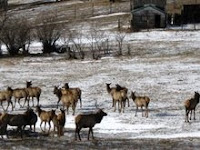
Last Thursday, February 5th, Rocky Mountain National Park began their new culling program to thin the Park's elk herd . Sharpshooters will be used to thin about 100 animals from the herds this year, which if allowed to overgraze might destroy many of the Park’s aspens and willows. That same day, in response to safety concerns when a 14-year-old had to fight off a coyote in the Denver metro area, the Greenwood Village City Council passed an ordinance allowing coyotes to be shot. A contractor will be paid $60 per hour, or $200 per day, to cull the habituated coyote population. Two years ago, a disoriented coyote was found huddling in a Chicago Starbuck’s next to the drink cooler, perhaps the closest thing to a cave he could find. More than ever before, we are being asked to explore what it means to co-exist – with one another, with the land, with the animals. When the Louis and Clark Expedition first encountered a coyote, they called it the Prairie Wolf. To many Native Americ...

Bison! Bison! Bison! The Red Canyon Ranch, the Vore Buffalo Jump, Artist Sarah Rogers, and Lessons of the Past

Image
Mike and Kathy Gear , authors of a gazillion novels and owners of the Red Canyon Bison Ranch in Wyoming, just received the Bison Producer of the Year Award at the National Western Stock Show in Denver. Their latest book, People of the Thunder, made the New York Times bestseller list within four days of release. Kathleen is a former state historian and archaeologist for Wyoming, Nebraska and Kansas (Department of the Interior), and Michael holds a master’s degree in archaeology. They can tell you not only where the great bison historically roamed, but they can also bring to life the pre-history characters whose lives depended on the buffalo. Speaking of pre-history, I’ve been a board member of the Vore Buffalo Jump Foundation for several years. The Vore Buffalo Jump is one of the most important archaeological sites of the late-prehistoric Plains Indians. Discovered during the construction of Highway I-90 in the early 1970’s, the Vore site is a natural sinkhole that was used as a b...